

Histogram Worksheet PDF: A Comprehensive Plan
Histogram worksheets, often available as PDF downloads, provide focused practice with data visualization. These resources frequently include multiple-choice questions and problems involving test scores,
time data, and speed limit analysis.
Many worksheets guide students through creating and interpreting histograms, estimating values, and understanding data distributions. Pre-Algebra level worksheets are also readily accessible.
What is a Histogram?
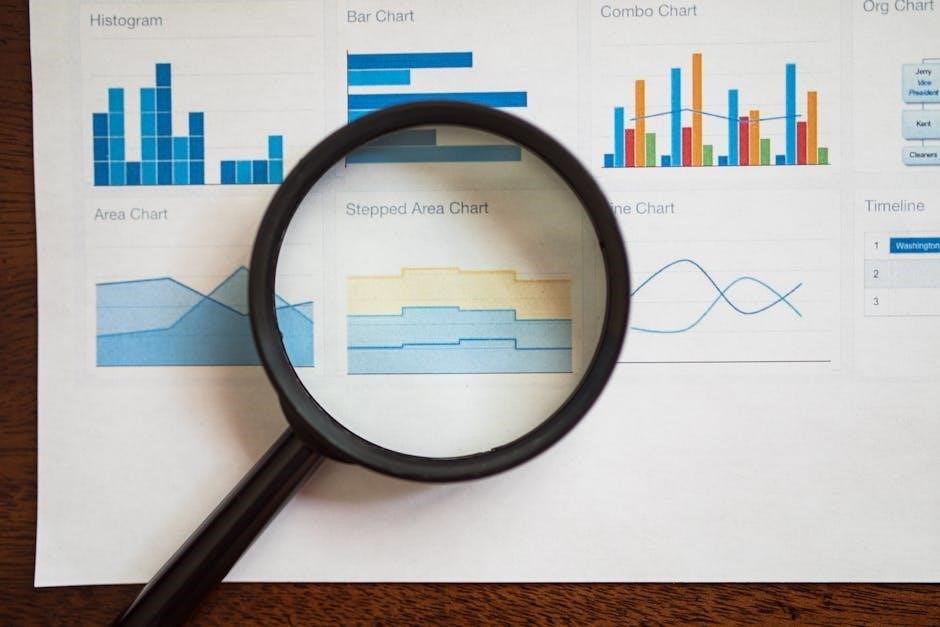
A histogram is a graphical representation of data, utilizing rectangles to display the frequency of values within specified intervals. Unlike a bar graph, which often compares distinct categories, a histogram illustrates the distribution of continuous data. The area of each rectangle corresponds to the frequency of data points falling into that particular interval, often called a “bin”.
Essentially, a histogram provides a visual summary of the underlying distribution of a dataset. It allows for quick identification of central tendency, spread, and skewness. Worksheet PDF resources frequently begin with defining this core concept, ensuring students grasp the fundamental purpose before tackling more complex problems.

Understanding histograms is crucial for interpreting data presented in various contexts, from test scores to commute times. These practice materials often emphasize the difference between histograms and bar graphs, solidifying this foundational knowledge. The visual nature of a histogram makes it a powerful tool for data analysis and communication, and PDF worksheets offer a convenient way to build proficiency.
Understanding Histogram Components
A histogram comprises several key components essential for accurate interpretation. The x-axis represents the data intervals, or “bins,” displaying the range of values. The y-axis indicates the frequency – the number of data points falling within each bin. Rectangles are erected above each bin, with their height proportional to the frequency.
Histogram worksheet PDF materials often focus on identifying these components. Students learn to read the scale of both axes and understand what the height of each bar signifies. Understanding the bin width is also crucial; it determines the granularity of the data representation.
Furthermore, worksheets emphasize the importance of continuous data and how it differs from categorical data, which is better suited for bar graphs. Practice problems frequently involve analyzing pre-made histograms to determine frequencies, bin sizes, and the overall shape of the distribution. Mastering these components is fundamental to successfully solving test-related questions and analyzing real-world data sets, like those involving call center times or commute durations.
Data Grouping and Bins
Data grouping, and the subsequent creation of “bins,” is a foundational step in constructing a histogram. Bins represent intervals of data values, allowing for a concise visual representation of a larger dataset. The choice of bin width significantly impacts the histogram’s appearance and interpretability.
Histogram worksheet PDF exercises often challenge students to determine appropriate bin sizes for given datasets. Too few bins can obscure important patterns, while too many can create a noisy, difficult-to-interpret graph. Worksheets frequently present scenarios requiring students to experiment with different bin widths to observe the resulting changes in the histogram’s shape.
Understanding how to group continuous data into meaningful intervals is key. Practice problems may involve calculating frequencies for each bin and then using those frequencies to construct the histogram. These exercises reinforce the connection between raw data, binning, and the visual representation. Analyzing time data, such as call center response times, often requires careful consideration of bin size to reveal meaningful trends.
Frequency and Relative Frequency
Frequency represents the number of data points that fall within each bin of a histogram. Histogram worksheet PDF materials heavily emphasize calculating these frequencies as a crucial step in histogram construction. Students learn to tally data and accurately represent these counts visually.
However, worksheets also introduce the concept of relative frequency – the proportion of data points within each bin, expressed as a percentage or decimal. This normalization allows for comparisons between datasets of different sizes. Practice problems often require converting frequencies to relative frequencies and vice versa.
Understanding the difference between absolute and relative frequencies is vital for accurate interpretation. Worksheets may present scenarios involving test scores or commute times, asking students to calculate both types of frequency and analyze the resulting distributions. Exercises often include interpreting histograms based on either frequency or relative frequency scales, reinforcing the connection between data representation and statistical meaning.
Creating a Histogram from Data
Histogram worksheet PDF resources dedicate significant space to guiding students through the process of constructing histograms from raw data. These worksheets typically begin with defining appropriate bin sizes and establishing a clear range for the data set. Students learn to organize data into these bins, often through tallying or creating frequency tables.
A key component involves accurately representing the frequency or relative frequency of each bin using bars. Worksheets provide examples and practice problems, often using test scores or time data (like call center response times or commute times) as the basis for histogram creation.
Many worksheets emphasize the importance of labeling axes correctly and choosing an appropriate scale. Pre-Algebra level worksheets may offer pre-defined bin ranges, while more advanced materials require students to determine optimal bin sizes themselves. Step-by-step instructions and visual aids are common features, ensuring students grasp the fundamental principles of histogram construction.
Interpreting Histogram Shapes
Histogram worksheet PDF materials heavily emphasize the ability to interpret the shapes presented by histograms, linking these shapes to underlying data characteristics. Worksheets commonly present histograms and ask students to identify whether the distribution is symmetrical, skewed left, or skewed right.
Practice problems often involve analyzing histograms displaying test scores, commute times, or call center data, prompting students to describe the distribution in terms of its central tendency and spread. Understanding the implications of skewness – for example, a left skew indicating a concentration of higher scores – is a core skill reinforced through these exercises.
Many worksheets include questions requiring students to estimate the mode and potential location of the mean and median based solely on the histogram’s shape. Advanced worksheets may ask students to compare and contrast different histograms, identifying key differences in their distributions. The goal is to develop a strong visual literacy for data representation.
Using Histograms to Identify Data Distribution
Histogram worksheet PDF resources are designed to help students master identifying various data distributions through visual representation; A key focus is recognizing whether data is uniformly distributed, normally distributed, or exhibits skewness. Worksheets present histograms generated from datasets like test scores, commute times, and call center response times, prompting analysis.
Practice exercises frequently ask students to determine if a distribution is symmetrical, and if not, to identify the direction and degree of skew. Students learn to connect the shape of the histogram to the characteristics of the underlying data – for example, a longer tail to the right indicates positive skewness.
Many worksheets include questions requiring students to explain how the histogram’s shape relates to the data’s central tendency and variability. Some PDF materials also introduce concepts like outliers and their impact on the distribution’s appearance. The ultimate aim is to build a strong intuitive understanding of how histograms reveal patterns within data.
Mean, Median, and Mode on a Histogram
Histogram worksheet PDF materials often integrate exercises that connect the visual representation of data with measures of central tendency: mean, median, and mode. Students learn to estimate these values directly from the histogram’s shape. For instance, the median can be approximated by identifying the midpoint of the distribution’s area.
Practice problems frequently involve estimating the mean by visually assessing the balance point of the histogram. Worksheets may present scenarios, like analyzing test scores, where students must calculate or estimate these measures based on the histogram. Some resources guide students to understand how skewness affects the relationship between the mean, median, and mode.
Advanced worksheets might ask students to compare and contrast the values, explaining which measure best represents the “typical” value in different distributions. The goal is to solidify the understanding that a histogram isn’t just a visual display, but a tool for extracting key statistical insights.
Histogram vs. Bar Graph: Key Differences

Histogram worksheet PDF resources dedicate sections to clarifying the distinctions between histograms and bar graphs, a common point of confusion. These materials emphasize that histograms display the distribution of continuous data, grouped into bins, while bar graphs represent categorical data;
Practice exercises often involve identifying whether a given dataset is best represented by a histogram or a bar graph. Worksheets highlight that histograms have adjacent bars touching, signifying continuous ranges, whereas bar graphs have spaces between bars, representing distinct categories.
Many PDFs include comparative examples, showing the same data visualized as both a histogram and a bar graph to illustrate the differing interpretations. Students learn that histograms focus on frequency distribution, while bar graphs emphasize comparisons between categories. Some worksheets include questions asking students to explain why a particular graph type is more appropriate for a given dataset, reinforcing conceptual understanding.
Practice Problems: Estimating Values from Histograms
Histogram worksheet PDFs heavily feature practice problems centered around estimating values directly from histograms. These exercises commonly present a histogram depicting data like test scores or commute times, and ask students to estimate the number of data points falling within specific ranges or bins.
A frequent problem type involves determining the approximate median or mean from the histogram’s shape. Worksheets often include scenarios requiring students to estimate percentages – for example, the percentage of students scoring above a certain mark.
Many PDF resources provide step-by-step guidance on how to approach these estimations, emphasizing the importance of understanding bin widths and frequencies. Some worksheets present real-world contexts, like analyzing call center response times, to make the practice more relatable. Students are often asked to justify their estimations, promoting critical thinking and data interpretation skills. These exercises build proficiency in extracting meaningful information from visual representations of data.
Histogram Worksheets: Types and Availability (PDF Focus)
Histogram worksheet PDFs are widely available online, catering to diverse skill levels from pre-algebra to more advanced statistical concepts. Common types include worksheets focusing on creating histograms from raw data, interpreting existing histograms, and comparing histograms to other data displays like bar graphs.
Many PDFs offer a mix of problem types, including multiple-choice questions, fill-in-the-blank exercises, and open-ended problems requiring detailed explanations. Some worksheets specifically target real-world applications, such as analyzing test scores, commute times, or call center data.
Resources like educational websites and test preparation platforms frequently host free downloadable PDF worksheets. Paid resources often provide more comprehensive coverage, answer keys, and detailed solutions. The availability of PDF format ensures easy access and printing for classroom or individual practice. These resources are invaluable for reinforcing understanding and building confidence in histogram analysis.

Solving Problems Involving Test Scores and Histograms
Histogram worksheet PDFs frequently utilize test score data to illustrate practical applications of data visualization. These problems often require students to construct histograms from frequency distributions of scores, or to interpret pre-made histograms to estimate key statistics.
Common tasks include determining the number of students within specific score ranges, estimating the median or mean test score, and identifying the shape of the distribution (e.g., symmetrical, skewed). Worksheets may also present scenarios where students need to compare the performance of different groups based on their histogram representations.
Many exercises involve calculating percentages – for example, determining the percentage of students scoring above a certain threshold. The PDF format allows for clear presentation of data tables and histograms, facilitating effective problem-solving. These practice exercises build crucial skills in data analysis and interpretation, essential for success in statistics and related fields.
Analyzing Time Data with Histograms (Call Centers, Commute Times)
Histogram worksheet PDFs commonly feature real-world scenarios involving time data, such as call center response times and employee commute durations. These exercises demonstrate how histograms can effectively visualize and analyze distributions of time intervals.
Students might be asked to create histograms from data sets representing the time taken to answer incoming calls in a call center, or the commute times of a group of individuals. Interpreting these histograms involves estimating average times, identifying peak periods, and assessing the variability in the data.
Problems often require calculating the percentage of calls answered within a specific timeframe, or determining the number of employees with commute times exceeding a certain limit. The PDF format ensures clear presentation of the data and histograms, aiding in accurate analysis. These practice exercises highlight the practical utility of histograms in understanding and optimizing time-related processes.
Histograms and Speed Limit Analysis
Histogram worksheet PDFs frequently incorporate scenarios involving speed data and speed limits, providing practical applications of data visualization. These exercises demonstrate how histograms can be used to analyze the distribution of vehicle speeds and assess compliance with speed regulations.
Students might encounter problems where they are presented with data on the speeds of cars passing a certain point, and tasked with creating a histogram to represent this data. Interpreting the histogram involves estimating the percentage of cars exceeding the speed limit, or identifying the most common speed range.
Worksheets often require calculating the percentage of cars traveling under a specified speed limit (e.g., 60mph). The PDF format allows for clear presentation of the data and the resulting histogram, facilitating accurate calculations and interpretations. This type of practice reinforces the understanding of how histograms can be used in real-world applications like traffic safety analysis.
Multiple Choice Questions on Histograms

Histogram worksheet PDFs commonly feature multiple-choice questions designed to assess understanding of key concepts. These questions test a student’s ability to interpret histograms, identify data distributions, and apply their knowledge to practical scenarios. The PDF format ensures consistent presentation and easy accessibility for practice.
Typical questions might ask students to determine the frequency of data within specific bins, identify the shape of the distribution (symmetric, skewed), or estimate the median or mode from a given histogram. Some questions may present different histograms and ask students to select the one that best represents a given dataset.
These practice questions often cover topics like the difference between histograms and bar graphs, the impact of bin size on the histogram’s appearance, and the use of histograms to identify outliers. The inclusion of answer keys within the PDF allows for self-assessment and reinforces learning. These questions are valuable for quick review and exam preparation.
Working with Pre-Algebra Histograms
Histogram worksheet PDFs tailored for Pre-Algebra students focus on building a foundational understanding of data representation. These resources simplify the process of creating and interpreting histograms, often providing pre-defined data sets and grid templates. The PDF format allows for printable, offline practice, reinforcing skills without requiring digital tools.
Worksheets at this level typically guide students through the steps of organizing data, determining appropriate bin sizes, and calculating frequencies. Emphasis is placed on visually representing data and drawing basic conclusions about the distribution. Students learn to identify the range, minimum, and maximum values within a dataset.

These practice exercises often involve real-world scenarios, such as analyzing test scores or survey results. The worksheets frequently include prompts to describe the shape of the histogram and identify any patterns or trends. The goal is to develop a conceptual understanding of histograms before introducing more complex statistical concepts.

Resources for Additional Histogram Practice (PDF Downloads)
Numerous online platforms offer free histogram worksheet PDF downloads for supplemental practice. These resources cater to various skill levels, from introductory Pre-Algebra to more advanced concepts. Many educational websites provide comprehensive collections of worksheets, often categorized by topic and difficulty.

PDF formats ensure accessibility and ease of use, allowing students to print worksheets for offline completion. Search terms like “histogram practice PDF” or “data analysis worksheets” yield a wealth of options. Some resources include answer keys for self-assessment, while others offer detailed solutions to complex problems.
Specifically, worksheets focusing on interpreting histograms related to test scores, commute times, and speed limit analysis are readily available. These materials often incorporate multiple-choice questions and open-ended problems designed to reinforce understanding. Utilizing these PDF downloads provides students with ample opportunities to master histogram concepts and improve their data analysis skills.